Ask most shop owners why they haven't done video and the answer is almost always the same: no time, no camera gear, no idea what to film. None of those are the real reason. The real reason is that "video marketing" got sold to small businesses as a production problem, something you hire out or skip, when it has never been about production at all. The shops quietly winning with video right now are filming on the same phone in their pocket, posting it unedited, and using it to answer the one question every customer is silently asking before they approve an estimate.
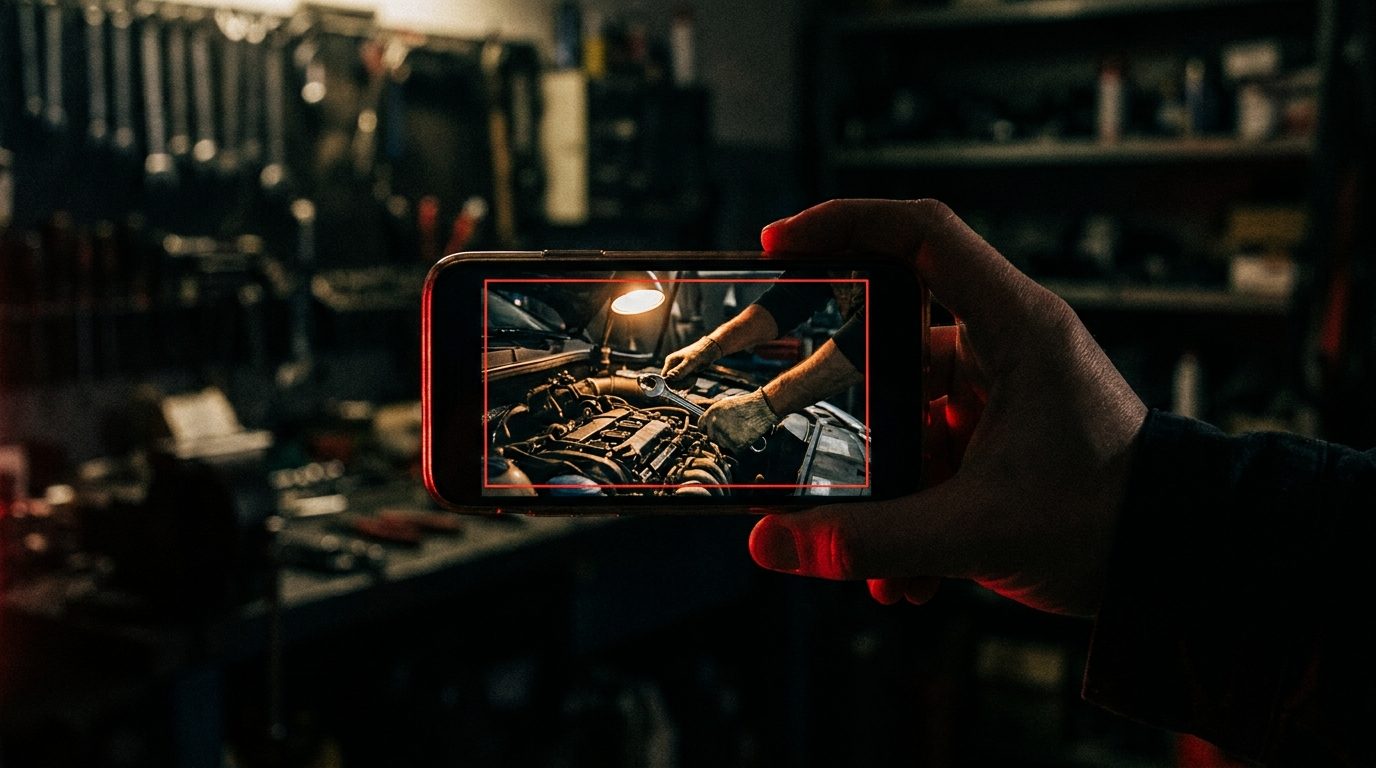
Why most shops get video wrong.
Two kinds of shops try video and quit. The first hires a local videographer for a "brand video," gets a polished 90-second reel with a drone shot of the building and a voiceover, posts it once, and never films again because the next one costs another $800 and two weeks of scheduling. The second downloads TikTok, films a trending sound with a wrench as a prop, gets a few hundred views, and concludes video "doesn't work for a shop like ours." Both are solving the wrong problem. Neither one is asking what a video is actually for.
A video's job in a repair shop's marketing is not to look impressive. It is to remove doubt, at the exact moment doubt is highest, which for this industry is almost always the moment a customer looks at an estimate and wonders if the shop is telling the truth. Written estimates, no matter how detailed, cannot show a customer a worn brake pad next to a new one. A photo comes close. Thirty seconds of video showing the actual part, in the actual bay, narrated by the actual technician, closes that gap completely. That is the entire strategy. Everything below is just the mechanics of doing it consistently.
Five myths keeping shops off camera.
Before getting into what to film, it's worth clearing out the assumptions that keep most shops from ever starting.
- Myth: you need a real camera. A phone from the last three years shot in good bay lighting, ideally near an open door or a work light rather than straight overhead fluorescents, produces footage that is more than good enough. The audience for this content is a local customer trying to decide whether to trust a specific shop, not a film festival judge. Authenticity reads as more credible than polish here, not less.
- Myth: you need to post daily to see anything from it. Two to three intentional videos a week, each tied to an actual job that happened that day, beats seven rushed posts made just to hit a number. A shop that films three real repair explainers a week for two months has a library of 24 to 30 pieces of proof to pull from in ads, on the website, and on the Google Business Profile. Volume for its own sake produces filler nobody watches.
- Myth: only educational how-to content works. Educational tips have their place, but they are the format every shop's competitor also tries first, which makes it the most crowded lane. Testimonials, repair walkarounds, and a plain shot of a genuinely busy shop on a Tuesday afternoon often outperform another "how to check your tire pressure" clip, because they answer trust questions rather than teach a skill nobody was asking to learn.
- Myth: more views means more customers. A video that reaches 50,000 people outside the service area produced zero bookings for more than one shop we've reviewed. A video that reaches 800 people, all of them within 12 miles and already following the shop's Google Business Profile or previous ad, can produce several calls. Local relevance beats reach every time in this category.
- Myth: video is only for younger, social-media-native customers. The customer watching a repair walkaround video embedded on a service page or in the Google Business Profile photo gallery is very often the same customer who already called and is deciding between two estimates. That has nothing to do with age. It has to do with where in the decision process the video shows up, which is the entire subject of the next section.
Video marketing for a repair shop is not a content format. It is proof, delivered on camera, at the exact moment a customer is deciding whether to trust the invoice in front of them.
Free Video & Content Audit
Want a filming plan built around your actual shop, not a generic checklist?
We'll look at your current content, your Google Business Profile, and your ad accounts, then hand you a simple weekly filming list built for what you already have going on in the bays. Free, no obligation.
Get My Free Audit →What to actually film with a phone.
Forget the idea of a content calendar full of clever concepts. The best video content a repair shop can produce is already happening in the bay every single day. It just has to get pointed at.
The repair walkaround
Thirty to 60 seconds, filmed the moment a worn part comes off the vehicle. Hold the old part next to the new one, say what it was doing wrong in plain language, and say what the fix costs in the same breath if the customer has already approved it. This single format does more to shrink declined estimates than any other piece of content on this list, because it turns an invoice line item into something the customer watched happen.
The real testimonial, not the scripted one
Skip the studio-lit sit-down interview. Catch a genuinely happy customer picking up their car and ask one question on camera: "what was going on with the car, and how'd it go today?" Fifteen honest seconds beats ninety scripted ones, and it costs nothing but asking at the right moment.
The busy-shop proof shot
A wide, unedited ten-second clip of a full parking lot or every bay occupied on a Tuesday morning is one of the most persuasive things a prospective customer can see, because it silently answers "is this a shop other people actually trust" without saying a word.
The technician introduction
A single technician, on camera for 20 seconds, saying their name, how long they've worked on cars, and one thing they specialize in. Paired with the "same face every visit" positioning most independent shops already have over a chain, this format turns an anonymous mechanic into a specific person a customer already half-trusts before walking in.
The seasonal or timely check
A quick clip explaining what to check before a road trip, before summer heat, or before winter, filmed on the actual vehicle in the bay rather than a generic stock explainer. It works double duty as both a useful tip and a subtle reminder that the shop is paying attention to the calendar.
The parts-and-invoice close-up
A slow, ten-second close-up of the worn part sitting next to the printed invoice line describing it, no talking required. It sounds too simple to matter, but this is the single most re-shareable clip a shop can produce for a customer who wants to show a spouse or a parent exactly what they paid for, and it doubles as proof if a warranty question ever comes up later.
Where each video actually belongs.
The single biggest reason video efforts stall out is that shops film good clips and then post all of them to one place, usually Instagram, and call it done. Different footage belongs in different spots in the funnel, and matching them correctly is where the actual return shows up.
Google Business Profile. This is the highest-leverage, lowest-effort placement most shops skip entirely. A profile with a handful of repair walkaround and testimonial clips in the photo and video section outperforms a profile of static stock-feeling photos, and it sits directly in front of someone actively comparing shops in the map pack right now.
The website, on the actual service pages. A brake service page with one 30-second repair walkaround embedded near the top does more for conversion than another paragraph of copy. It is proof placed exactly where a visitor is deciding whether to call, which is the same principle covered in more depth in our SEO and on-page conversion work.
Social platforms, for awareness. Instagram and TikTok are the right home for the casual, personality-driven clips, the technician introductions, the shop culture moments, the seasonal tips. These build familiarity over weeks and months rather than producing an immediate call, which is exactly the role they should play. We cover platform selection and posting cadence in full in our social media marketing guide, worth reading alongside this one.
Paid ad creative. The highest-intent placement of all. A tightly cropped, five to eight second clip of an actual repair or a real testimonial line, used as Meta ad creative aimed at people who haven't chosen a shop yet, consistently outperforms static image ads for this industry because motion and an authentic voice stop the scroll faster than a photo. Paired with Google Ads targeting the exact repair someone is searching for, these clips can start producing calls within 24 to 48 hours of launch, a timeline no amount of organic posting can match.
A video posted with no destination in mind is content. A video placed where a specific customer is deciding is marketing.
A system any shop can run without an editor.
Consistency beats production value, but consistency still needs a system or it dies in week three. Most shops that quit didn't quit because the videos underperformed, they quit because nobody owned the process past the first excited week. Here is the version we set up for shop clients who have never filmed anything before, built to survive a busy Monday without anyone remembering it's "video day."
- Assign one person, not "whoever has time." A service advisor or a shop manager who already carries a phone all day is usually the right owner, not the busiest technician. The job takes 90 seconds per clip, not a production shift.
- Film in the moment, not on a schedule. Waiting for a dedicated "video day" is how this dies. The moment a worn part comes off a car that has an interesting story, film it immediately, before the part gets thrown out.
- Batch the posting, not the filming. Film as jobs happen through the week, then spend 15 minutes on Friday trimming clips in the phone's native editor and scheduling them across the Google Business Profile, social accounts, and a folder for the ad team to pull from.
- Keep a running raw folder. Every clip, used or not, gets saved to a shared folder by date. Three months in, that folder is a library an ad campaign or a website refresh can pull from without filming a single new thing.
- Set one weekly minimum, not a daily quota. Three clips a week, chosen from whatever actually happened in the bay, is sustainable indefinitely. Seven clips a week rushed to hit a number gets abandoned by month two.
The system that survives is the one built around what's already happening in the shop, not one that requires the shop to invent content on top of a full schedule.
Skip The Trial And Error
We turn shop footage into ad creative that actually books appointments.
Send us the raw clips your team is already filming and we'll cut, caption, and place them where they convert, on the Google Business Profile, the website, and as Meta and Google ad creative. No production crew required.
Get My Free Audit & Roadmap →Mistakes that waste the effort.
A handful of avoidable habits account for most of the wasted filming we see when we take over a shop's marketing:
- Filming vertically for a landing page, or horizontally for Instagram Stories. Match the format to the destination before hitting record, not after. Re-shooting is free. Re-cropping badly is not.
- No captions. Most video is watched with sound off, especially in feeds and on the Google Business Profile. A simple auto-caption pass in the phone's editor is the single highest-return five minutes in the whole process.
- Letting the raw footage die in a camera roll. Filming without a destination in mind is how a shop ends up with 40 unused clips and nothing to show for the effort. Every clip should have a home before it's filmed, even if that home is just the raw folder for later.
- Treating one great video as "done." A single viral or well-performing clip creates a temptation to relax. The shops that keep winning are the ones who treat that clip as proof the format works and do more of it immediately, not as a finish line.
- Falling back on paid production for everything. A polished quarterly brand video still has a place for a website hero or a big campaign launch, but it cannot replace the weekly drip of authentic, unpolished proof that actually builds trust. Reserve the paid crew for the rare moment that calls for it, and keep the phone running the rest of the time.
None of this requires a marketing background, expensive equipment, or a weekly time commitment beyond what a busy service advisor can spare. It requires pointing a phone at the real work already happening and putting the result where a deciding customer will actually see it. Shops that treat this as a standing habit rather than a one-time project are the ones still filming, and still converting, a year from now.
Free Video & Content Audit
Turn what's already happening in the bay into your best marketing asset.
We'll show you exactly what to film this week and where each clip should go to actually produce booked appointments.
Received
Thanks. Talk soon.
We'll reach out within 24 hours with your custom 90-day roadmap.
Frequently asked
questions.
Do I need a real camera or a video editor to start?
No. A recent smartphone shot in landscape or vertical with a clean lens and decent lighting outperforms most small-agency produced video for this purpose, because the point is proof, not polish. Trim clips in the phone's built-in editor or a free app. The moment a shop hires an outside crew for every video, output drops to one clip a quarter instead of one a week, and consistency beats production value here.
What's the single best video to film first?
A 30 to 60 second walkaround of a real repair in progress, narrated in plain language, showing the actual worn part next to the new one. It works because it answers the exact question a customer is quietly asking on every invoice: was this actually necessary. That one video format alone, filmed consistently, does more to reduce declined estimates and build trust than any other single piece of content a shop can produce.
Where should these videos actually be posted?
Split them by job. Trust-building repair and testimonial clips belong on the Google Business Profile and the website, where a searcher already deciding between shops will see them. Short, casual clips belong on Instagram and TikTok for awareness. The highest-intent clips, a fast close-up of the actual damage or repair, work best as Meta ad creative aimed at people who have not chosen a shop yet, because they can start producing calls within 24 to 48 hours of launch.