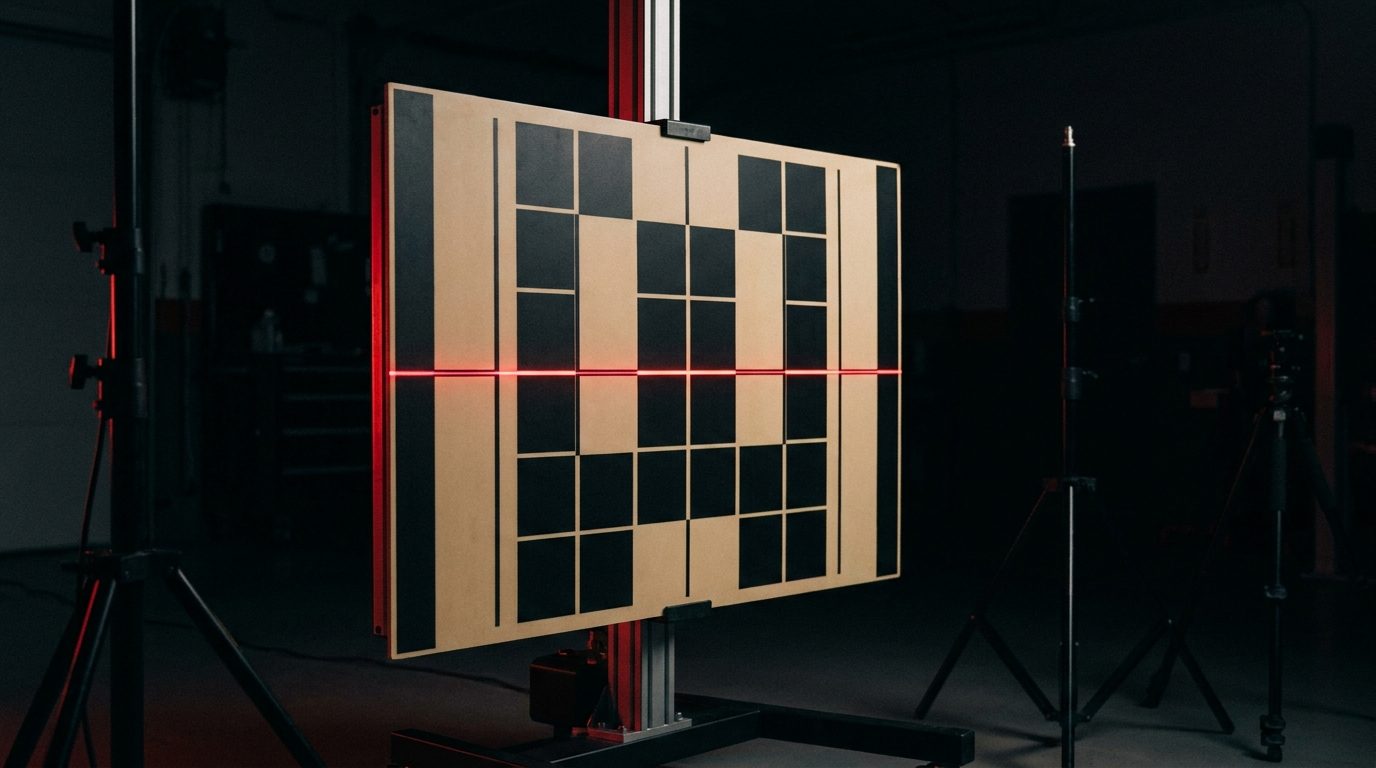
A lot of shops spent five figures on a calibration frame, a set of targets, and the training to run them, then never told anyone outside the building. The equipment sits in the back bay, the technician gets certified, and the work still mostly arrives the same way it always did: a collision shop calls asking for a favor, or a customer's insurance adjuster mentions it in passing after a windshield claim. Meanwhile the shop across town with the identical machine is running paid ads for the exact keyword a driver types the moment their lane-keep warning light won't turn off. The equipment isn't the differentiator anymore. Almost every serious shop in a metro area has access to one now, either owned or through a mobile calibration partner. What separates the shop that fills its calibration bay from the one that lets it sit idle between referrals is whether anyone bothered to market the service at all.
- 01Why calibration is the highest-margin service most shops still give away
- 02Three myths keeping shops from marketing calibration work
- 03Building a calibration page that actually gets found
- 04Turning insurance and DRP calibration work into a marketing asset
- 05The 30-day system for launching calibration marketing
- 06Frequently asked questions
Why calibration is the highest-margin service most shops still give away.
The math behind calibration is unusual compared to most of the work that comes through a shop's bay doors. A windshield replacement, a bumper repair, or a sensor swap requires calibration, and that calibration job runs its own labor line, often at a rate that doesn't compete with a customer cross-shopping oil change prices down the street, because most vehicle owners have no idea what a fair price for calibration even looks like. There's no coupon culture around it, no discount aggregator site undercutting the job, and very little of the race-to-the-bottom pricing pressure that shows up everywhere else in auto repair advertising.
And the volume of vehicles that need it keeps climbing regardless of what any individual shop does to market it. Industry research puts the share of vehicles on the road today carrying at least one ADAS component, forward collision warning, lane departure warning, adaptive cruise, a forward-facing camera, at roughly six in ten and climbing every model year. Every one of those systems requires recalibration the moment its sensor is touched, moved, or replaced, whether that's from a windshield swap, a bumper repair, a wheel alignment, or something as small as a suspension component being disconnected and reconnected. The demand isn't seasonal and it isn't optional. A car with a camera that's out of alignment after a repair is a liability the shop that did the repair doesn't want sitting on its lot, and a driver whose lane-keep system just started drifting wants it fixed now, not eventually.
The gap is that most of that demand never reaches a shop through a channel anyone actually built on purpose. Independent estimates from equipment manufacturers and industry publications suggest a large majority of calibrations performed after a repair are still referred out to a dealer, a specialty calibration center, or a mobile provider, even at shops that own the equipment to do the job themselves. Every one of those referrals is a job, and the margin that comes with it, leaving the building. A shop that markets the service directly keeps more of that work in-house instead of functioning as an unpaid lead generator for whichever specialist happens to have the better relationship with the collision shop down the road.
There's a second cost to referring the work out that rarely shows up on a P&L line but matters just as much: control over quality. A shop that hands a customer's car to a third party for calibration is also handing over the comeback risk. If that calibration isn't done correctly and a warning light returns two weeks later, the customer calls the shop that did the original repair, not the calibration provider nobody remembers the name of. Keeping the work in-house means the shop that stands behind the repair is also the one that verified the safety system tied to it, which is a stronger position with both the customer and, eventually, with an insurance carrier reviewing a claim.
Three myths keeping shops from marketing calibration work.
Ask a shop owner why they've never run an ad or built a dedicated page for calibration, and the answer usually falls into one of three excuses, all of which sound reasonable and are all wrong in practice.
Myth one: customers don't know what ADAS calibration is, so there's nothing to market. True, most vehicle owners have never heard the term ADAS. But they've absolutely noticed the symptom. "Lane assist keeps turning itself off," "warning light came on after I got my windshield replaced," "backup camera lines are crooked now" are searches real people type into Google constantly, and none of them require the searcher to know the technical name for what's wrong. A shop doesn't need to educate the market on terminology before it can capture the search. It needs a page and an ad that speak the symptom language the customer already uses, then explain the fix once they've landed.
Myth two: calibration work comes through referrals, so paid marketing is a waste. Referral work and direct-to-consumer demand aren't the same pool, and treating them as interchangeable is how a shop ends up with an empty calibration bay in the weeks a collision partner happens to be slow. The driver who just bought a used vehicle privately and wants the ADAS system verified, or the customer who had a windshield replaced at a glass-only shop that doesn't calibrate, never touches a collision shop's referral pipeline at all. That demand only shows up if a shop is actually visible when someone searches for it directly.
Myth three: it's a technical, low-volume service, so it isn't worth its own campaign. Low search volume compared to "auto repair near me" is true, and it's also the reason calibration keywords are some of the cheapest, least competitive terms a shop will ever bid on in Google Ads. A specialty service with low competition and a high average ticket is close to the ideal setup for a small, efficient paid search campaign, not a reason to skip marketing it.
Free Calibration Marketing Audit
See how many calibration searches you're missing right now.
We'll pull the local search volume for ADAS and calibration keywords in your market and show you exactly what a dedicated campaign would look like.
Get My Free Calibration Audit →Building a calibration page that actually gets found.
Most shops that do mention calibration online bury it as one bullet point on a long services list, sandwiched between tire rotations and belt replacements. That's the same as not marketing it at all, because nobody searching for "ADAS calibration near me" or "windshield replacement camera reset" is going to scroll a generic services page hoping the term shows up. It needs its own page, built the same way a shop would build a landing page for any specialty service with its own demand and its own buyer.
The page needs to do a few specific jobs. First, it has to speak both languages: the technical searcher who already knows the term ADAS, and the symptom searcher who just knows something feels wrong since their last repair. Second, it needs to explain, in plain language, why calibration matters, not as a scare tactic but as a genuine safety and liability point: a forward collision system that's misaligned by even a few degrees can fail to trigger when it should, or trigger when it shouldn't. Third, it needs proof the shop actually has the equipment and the training to do the job correctly, which matters more here than almost any other service, since a customer has no easy way to verify calibration quality themselves.
A calibration page that only lists the manufacturer systems a shop can calibrate, without explaining the symptoms that send a driver searching in the first place, is invisible to the majority of people who need the service but don't yet know its name.
Once the page exists, a narrow Google Search campaign built around calibration and symptom keywords, paired with a Local Services Ads listing if the shop qualifies, captures the direct-response searcher fast. Meta plays a different role here: rather than cold prospecting for calibration specifically, a small retargeting and lookalike campaign aimed at people who've interacted with the shop's other content, especially collision or glass-related posts, tends to outperform cold interest targeting, since calibration awareness is still low enough that broad interest categories don't exist to target against yet.
What the proof section should actually include.
Because a customer can't visually inspect whether a calibration was done correctly, the proof section of the page carries more weight than it would on a typical service page. The strongest version includes the specific manufacturer systems and scan tools the shop supports, since that level of detail signals real capability far better than a generic "we do ADAS" claim. It should also name the equipment brand if the shop is comfortable doing so, note whether calibrations are performed in-house on a dedicated target range rather than outsourced to a mobile technician, and mention any manufacturer-specific training the technician has completed. None of that requires exaggeration. It just requires actually saying the specific things a shop already knows how to do instead of assuming the customer will take competence for granted.
Turning insurance and DRP calibration work into a marketing asset.
Most of the calibration volume flowing through a shop right now likely comes from insurance claims and direct repair program relationships, and that's not a problem to fix, it's leverage most shops never use. Every calibration a shop performs correctly and documents thoroughly is proof it can point to when marketing to the two audiences that actually decide where referral work goes: collision shops without in-house calibration equipment, and insurance adjusters who want a shop on their approved list that won't create a comeback claim.
We run Google Search and Local Services Ads alongside content for Network Collision, a Gilbert, Arizona collision shop, and the pattern holds there the way it does everywhere: the shops that treat their calibration documentation as a sales tool, pairing before and after scan reports with a short case study format, close new referral relationships faster than shops that just tell a prospective partner "we do that too" without proof. A one-page capability sheet built from real completed jobs, sent to every glass shop, tire shop, and independent mechanical shop within a reasonable radius that doesn't own calibration equipment, is a direct-mail-adjacent tactic that still works here specifically because it's targeted at other businesses rather than blasted at consumers, and because the offer genuinely solves a problem those shops have.
That referral outreach and the direct-to-consumer campaign described above aren't competing priorities. They pull from different pools of demand entirely, and a shop running both keeps the bay fuller in more weeks of the year than either one alone.
The 30-day system for launching calibration marketing.
None of this requires a rebuilt website or a six-month strategy engagement. A shop can have a functioning calibration marketing system live inside a month.
Week one: build the page. Write the dedicated calibration landing page covering both technical and symptom search language, the makes and systems the shop can calibrate, the equipment and certification proof, and a clear call to action. This is the single highest-leverage step, since every other tactic below depends on having somewhere to send traffic.
Week one, in parallel: pull the capability sheet together. Gather two or three recent completed calibration jobs, before and after scan documentation if available, and turn them into a simple one-page overview a shop can hand to a partner or attach to an email.
Week two: launch the paid search campaign. A narrow Google Search campaign built around the symptom and technical keyword list, pointed at the new landing page, with call tracking in place from day one so every lead is attributable. Because calibration keywords carry lower competition than general repair terms, this campaign typically produces its first calls within 24 to 48 hours of going live.
Calibration keywords are cheap and specific enough that a shop testing this for the first time can usually see whether the campaign works within the first two weeks of spend, long before committing to a bigger monthly budget.
Week three: send the referral outreach. With the capability sheet ready, reach out to every glass shop, tire shop, and independent mechanical shop in range that doesn't have in-house calibration equipment. A short, direct email or an in-person drop-off with the one-pager works better here than a cold call, since it gives the recipient something concrete to evaluate rather than a pitch to sit through.
Week four: layer in retargeting and review the first data. Launch the Meta retargeting campaign aimed at site visitors and existing customer lookalikes, and pull the first two weeks of Search campaign data to see which keywords and which symptom phrases are actually converting into booked appointments. Shift budget toward whichever terms are working rather than spreading it evenly across the full keyword list.
Built and Launched For You
Let's get your calibration campaign live this month.
We'll build the landing page, launch the Search campaign, and put together the referral capability sheet, all inside your first 30 days.
Get My Free Calibration Audit →The shops that will still be referring calibration work out a year from now aren't losing that revenue because the service is hard to sell. They're losing it because nobody ever built the page, ran the ad, or sent the outreach that would have kept it in-house in the first place. The equipment is already paid for either way. For the fuller marketing system this fits inside, see our collision shop marketing guide, our complete Google Ads for auto repair shops breakdown, our auto repair shop marketing guide, and our SEO page for the organic side of getting a calibration page ranking long term.
Free Calibration Marketing Audit
Stop referring the work out for free.
We'll show you the calibration search volume and campaign built for your market.
Received
Thanks. Talk soon.
We'll reach out within 24 hours with your custom 90-day roadmap.
Frequently asked
questions.
Do customers actually search for ADAS calibration by name?
Some do, especially owners of newer vehicles who were told by a dealer or insurance adjuster that calibration is required, but most searches use symptom or service language instead, phrases like lane assist not working, windshield replacement camera reset, or check engine light after new windshield. A calibration page built to answer both the technical searches and the symptom searches captures a much wider slice of the demand than one written only for people who already know the term.
Should I market calibration if most of my work already comes through insurance and DRP referrals?
Yes, because DRP referral volume and direct consumer demand pull from different pools and rarely compete with each other. Referral work fills a shop's calibration bay with jobs it did not have to find, while direct marketing captures the vehicle owner who searches before an insurance claim even exists, such as someone who just bought a used vehicle with ADAS and wants it verified. Running both means the bay stays full even in weeks when referral volume dips.
What's the difference between marketing calibration to collision shops versus vehicle owners?
Marketing to other collision and mechanical shops is a B2B referral play built on relationships, turnaround time, and trust, closer to a sales process than an ad campaign. Marketing to vehicle owners is direct response, built around near-me search intent and a landing page that explains why calibration matters after glass work, a repair, or a sensor replacement. Shops that only build one of the two are leaving the other pool of demand for a competitor to pick up.
How fast can a calibration-focused campaign start producing calls?
A Google and Meta campaign built specifically around calibration keywords and audiences typically starts producing calls and form fills within 24 to 48 hours of launch, the same speed advantage direct response campaigns have always had over organic channels that take months to build authority.
What monthly budget makes sense for a shop just starting to market calibration work?
A single-location shop can typically test calibration-specific paid search starting between $800 and $1,500 a month, since the keyword volume for a specialty service is naturally lower than a broad service like oil changes or brakes, which means the budget goes further per lead. Shops that also run collision or glass-shop referral outreach alongside paid search tend to see the fastest combined bay utilization.